Soft Skills: The "Hidden" 2026 Salary Multiplier
March 9th, 2026
Market Analysis
Takeo
March 9th, 2026
Market Analysis
Takeo
In 2026, the "Great Junior Squeeze" has proven one thing: code is now a commodity. With AI agents writing boilerplate in seconds, the technical floor has risen, but the ceiling for salary growth has shifted entirely toward human-centric capabilities.
Hiring managers aren't just looking for someone who can "talk to the machine"; they are desperate for engineers who can talk to the business.
The 2026 Reality: By the Numbers
The 3 "Human" Skills That Triple Your Market Value
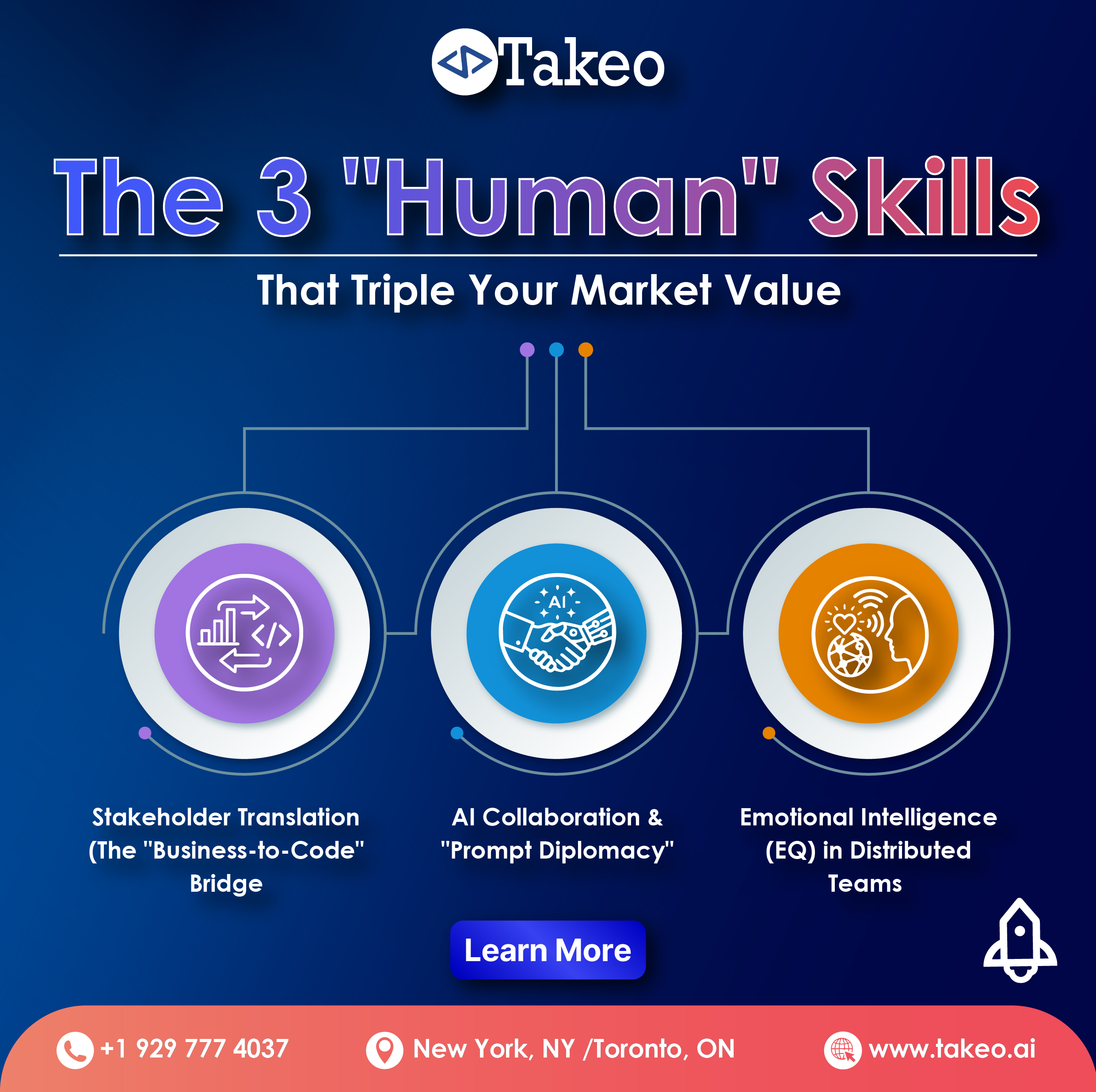
1. Stakeholder Translation (The "Business-to-Code" Bridge)
In 2026, the most valuable engineer is the one who can sit in a boardroom, understand a business problem, and translate it into a technical roadmap.
2. AI Collaboration & "Prompt Diplomacy"
As teams move toward Human-AI Hybrid Workflows, the ability to manage a team of AI agents and human developers is a specialized leadership skill.
3. Emotional Intelligence (EQ) in Distributed Teams
With 68% of the tech sector working remotely in 2026, "digital empathy" is the glue that prevents burnout and attrition.
Why "Self-Taught" Often Falls Short on Soft Skills
You can learn Python on YouTube, but you can’t learn Technical Leadership in a vacuum. Most self-taught developers hit a "Salary Ceiling" because they lack the high-level communication and collaboration experience that only comes from structured, mentored environments.
The Takeo Methodology: Building the "Whole" Engineer
At Takeo, we don't just hand you a certificate; we prepare you for the 2026 boardroom.
Conclusion: Don't Just Be a Coder. Be a Leader.
In the age of AI, "knowing how to code" is the entry fee. Soft skills are the multiplier. If you want to break into the $130k+ salary bracket, you need to invest in the skills that AI can't replicate: Empathy, Leadership, and Strategy.
Stop being a replaceable part of the machine. Become the one who leads it.
In 2026, the "Great Junior Squeeze" has proven one thing: code is now a commodity. With AI agents writing boilerplate in seconds, the technical floor has risen, but the ceiling for salary growth has shifted entirely toward human-centric capabilities.
Hiring managers aren't just looking for someone who can "talk to the machine"; they are desperate for engineers who can talk to the business.
The 2026 Reality: By the Numbers
The 3 "Human" Skills That Triple Your Market Value
1. Stakeholder Translation (The "Business-to-Code" Bridge)
In 2026, the most valuable engineer is the one who can sit in a boardroom, understand a business problem, and translate it into a technical roadmap.
2. AI Collaboration & "Prompt Diplomacy"
As teams move toward Human-AI Hybrid Workflows, the ability to manage a team of AI agents and human developers is a specialized leadership skill.
3. Emotional Intelligence (EQ) in Distributed Teams
With 68% of the tech sector working remotely in 2026, "digital empathy" is the glue that prevents burnout and attrition.
Why "Self-Taught" Often Falls Short on Soft Skills
You can learn Python on YouTube, but you can’t learn Technical Leadership in a vacuum. Most self-taught developers hit a "Salary Ceiling" because they lack the high-level communication and collaboration experience that only comes from structured, mentored environments.
The Takeo Methodology: Building the "Whole" Engineer
At Takeo, we don't just hand you a certificate; we prepare you for the 2026 boardroom.
Conclusion: Don't Just Be a Coder. Be a Leader.
In the age of AI, "knowing how to code" is the entry fee. Soft skills are the multiplier. If you want to break into the $130k+ salary bracket, you need to invest in the skills that AI can't replicate: Empathy, Leadership, and Strategy.
Stop being a replaceable part of the machine. Become the one who leads it.
The world of Artificial Intelligence (AI) is undergoing a seismic transformation, reshaping industries and creating an unprecedented demand for skilled professionals. Recent data from the U.S. Bureau of Labor Statistics (BLS) reveals a remarkable 50% growth in AI-related job opportunities over the past two years within the United States alone. This surge not only highlights the ubiquitous integration of AI technologies across sectors but also signals a fundamental shift in the global employment landscape.
As we embark on an exploration of this burgeoning industry, it becomes evident that AI is not merely a technological advancement but a catalyst for economic and societal change. McKinsey forecasts an astonishing economic impact of $13 trillion by 2030 attributed to AI, underscoring its potential to drive significant value creation and reshape global markets.
The field of AI offers a plethora of career opportunities across diverse domains. Let's delve deeper into some of the most sought-after AI-related job titles in 2024, elucidating their respective responsibilities:
● Machine Learning Engineer: Machine Learning Engineers play a pivotal role in developing and deploying machine learning algorithms and models. They collaborate with cross-functional teams to analyze vast datasets, identify patterns, and optimize algorithms for performance and scalability. The demand for Machine Learning Engineers has surged by an astounding 90% year over year, positioning it as one of the most coveted roles in the AI landscape.
● Data Scientist: Data Scientists are instrumental in extracting actionable insights from complex datasets. Leveraging statistical techniques and machine learning algorithms, they uncover trends, forecast future outcomes, and drive data-driven decision-making. With an average salary ranging from $95,000 to $165,000 per year, Data Scientists remain in high demand across industries, including finance, healthcare, and e-commerce.
● AI Researcher: AI Researchers drive innovation by pushing the boundaries of AI technology through groundbreaking research. They explore novel algorithms, develop experimental prototypes, and publish their findings in academic journals. Job postings for AI Researchers have surged by 75% compared to the previous year, indicating a growing demand for individuals who drive AI innovation and discovery.
● Robotics Engineer: Robotics Engineers integrate AI with robotics technology to design and develop autonomous systems. They deploy AI algorithms for perception, planning, and control, enabling robots to perform tasks in dynamic environments. With the global robotics market projected to reach $560 billion by 2025, Robotics Engineers play a pivotal role in advancing automation across industries such as manufacturing, logistics, and healthcare.
To thrive in the competitive AI job market, individuals must cultivate a diverse skill set encompassing both technical expertise and soft skills. Here's an extensive breakdown of the essential skills and qualifications:
● Proficiency in Programming Languages: Mastery of programming languages such as Python, R, Java, and C++ is indispensable for implementing AI algorithms, manipulating datasets, and developing AI-driven applications. Python, in particular, has emerged as the lingua franca of AI due to its versatility, simplicity, and robust ecosystem of libraries such as NumPy, Pandas, and Scikit-learn.
● Deep Understanding of Machine Learning Algorithms: A comprehensive understanding of machine learning algorithms, including supervised learning, unsupervised learning, and reinforcement learning, is paramount. Familiarity with algorithms such as linear regression, logistic regression, decision trees, random forests, support vector machines, k-nearest neighbours, and neural networks is crucial for developing predictive models and solving real-world problems.
● Experience with Deep Learning Frameworks: Proficiency in deep learning frameworks such as TensorFlow and PyTorch is indispensable for building and training neural networks. These frameworks provide high-level abstractions, optimized performance, and extensive community support for developing complex deep-learning models for tasks such as image recognition, natural language processing, and reinforcement learning.
● Data Manipulation and Visualization: Strong skills in data manipulation and visualization are essential for exploring and analyzing large datasets. Proficiency in libraries such as Pandas, NumPy, Matplotlib, and Seaborn enables data scientists to preprocess, clean, and visualize data effectively, gaining insights and communicating findings to stakeholders in a compelling manner.
● Problem-Solving: The ability to approach complex problems methodically, break them down into manageable components, and devise innovative solutions is a hallmark of successful AI professionals. Problem-solving skills enable individuals to tackle diverse challenges, from optimizing algorithms for performance to addressing data quality issues and deploying AI solutions in real-world environments.
● Communication: Effective communication skills are essential for conveying technical concepts to non-technical stakeholders, collaborating with cross-functional teams, and presenting findings clearly and concisely. Strong communication skills foster collaboration, facilitate knowledge sharing, and ensure alignment between technical solutions and business objectives, driving successful AI implementations.
● Adaptability: The field of AI is dynamic and rapidly evolving, with new technologies, methodologies, and best practices emerging at a rapid pace. Adaptability is crucial for AI professionals to stay abreast of emerging trends, learn new skills, and pivot in response to evolving industry dynamics. Embracing a growth mindset and being open to continuous learning are essential for long-term success in the ever-changing landscape of AI.
Fortunately, a wealth of resources is available for individuals seeking to acquire AI skills and knowledge. From online courses offered by platforms like Coursera, Udacity, and edX to immersive bootcamps and degree programs offered by top universities, aspiring AI professionals have access to a myriad of learning opportunities tailored to their needs and preferences.
The AI industry presents unprecedented opportunities for individuals willing to embrace innovation and seize the future of work. With the demand for AI talent reaching new heights, now is the perfect time to embark on a rewarding career journey in this dynamic field. By equipping yourself with the requisite skills, staying abreast of emerging trends, and leveraging the wealth of learning resources available, you can position yourself for success in the AI landscape.
The benefits of pursuing a career in AI are manifold, ranging from competitive salaries and job security to the opportunity to drive transformative change and shape the future of technology and society. Don't let this moment pass you by—take the first step towards a fulfilling AI career today.
Share this blog with others who may be interested and join the conversation about the future of work in the age of AI. Together, let's unlock the boundless potential of artificial intelligence and pave the way for a future defined by innovation, collaboration, and endless possibilities.
Learn more and Apply to Takeo’s Generative AI Bootcamp: (https://www.takeo.ai/generative-ai-bootcamp)
The Gold Rush Of The Digital Age: Why AI Careers Are In High Demand: (https://www.takeo.ai/insights/why-ai-careers-are-in-high-demand)
10 Reasons Why You Should Learn Generative AI in 2024: (https://www.takeo.ai/insights/reasons-to-learn-generative-ai)

Greetings, AI enthusiasts. Welcome to the digital age, where technology reigns supreme and industries are evolving at the speed of light! From smartphones that seem smarter than us to self-driving cars cruising the streets, the impact of this digital revolution is undeniable.
Today, we're diving into one of the hottest topics in the job market: the skyrocketing demand for AI careers.
Artificial intelligence, or AI, isn't just the stuff of science fiction anymore—it's a real game-changer. Picture this: machines that can learn and adapt, making decisions without human intervention. It's no wonder AI is turning heads across industries worldwide. From breakthroughs in machine learning to mind-boggling advancements in deep learning, the journey of AI has been nothing short of extraordinary. And the best part? It's not just limited to one sector. AI is everywhere, from diagnosing diseases in healthcare to predicting market trends in finance to recommending binge-worthy shows in entertainment.
But let's rewind a bit and delve into the origins of AI. The concept of artificial intelligence has been around for decades, but it wasn't until recent years that we witnessed its meteoric rise. Thanks to leaps in computing power, availability of big data, and groundbreaking algorithms, AI has evolved from a niche field into a powerhouse of innovation. Remember when IBM's Deep Blue beat chess grandmaster Garry Kasparov back in 1997? That was just the tip of the AI iceberg.
Fast forward to today, and we've got AI systems that can outsmart us in games like Go, recognize faces in photos, and even generate eerily human-like text. It's like living in a sci-fi movie, except it's real life. And the implications are huge. With AI becoming increasingly capable, industries are reaping the benefits of automation, efficiency, and predictive analytics like never before. It's no wonder businesses are clamoring to get a piece of the AI pie.
So, what's fueling the frenzy for AI talent? Well, for starters, businesses are chomping at the bit to get their hands on AI technologies. Why? Because they're the secret sauce for driving innovation and gaining a competitive edge. Think about it: AI-powered systems can crunch mountains of data faster than you can say "data overload," uncovering insights that humans might miss. But here's the kicker: someone's gotta build, implement, and maintain these AI wonders. And that someone could be you! With traditional job roles getting an AI makeover and emerging fields popping up left and right, the demand for AI expertise is through the roof.
But it's not just about businesses wanting to stay ahead of the curve. There's also a growing awareness of the transformative potential of AI in addressing some of society's most pressing challenges. From improving healthcare outcomes to mitigating climate change, AI is seen as a powerful tool for positive change. As a result, governments, nonprofits, and research institutions are investing heavily in AI research and development, further driving the demand for skilled professionals in the field.
And let's not forget about the data deluge. In today's digital world, we're generating more data than ever before. Every click, swipe, and tap leaves behind a digital footprint just waiting to be analyzed. But here's the catch: all that data is worthless if we can't make sense of it. Enter AI. With its ability to sift through vast amounts of data, identify patterns, and extract valuable insights, AI is the key to unlocking the hidden potential of big data. And who better to unleash the power of AI than the next generation of AI rockstars?
Now, let's talk perks. When you jump on the AI bandwagon, you're not just signing up for a job—you're embarking on an adventure. Picture this: competitive salaries that'll make your piggy bank do a happy dance, jaw-dropping projects that'll make you the envy of your friends, and the chance to leave your mark on the world of technology. Plus, with AI skills under your belt, you're not tied down to one industry. You could be crunching data for healthcare today and teaching robots to dance tomorrow. Talk about versatility!
But it's not just about the glitz and glamour. There's also a profound sense of fulfillment that comes from working in AI. Whether you're developing algorithms to improve cancer diagnosis or creating chatbots to enhance customer service, every line of code you write has the potential to make a real difference in people's lives. And let's face it—there's something pretty cool about being at the forefront of innovation, pushing the boundaries of what's possible with technology.
But hey, it's not all rainbows and unicorns in AI land. Sure, the rewards are sweet, but the road to AI greatness isn't without its bumps. You'll need more than just a knack for technology—you'll need some serious education and technical skills. But fear not! In the ever-evolving world of AI, learning never stops. With a smorgasbord of online courses, certifications, and hands-on experiences at your disposal, you'll be leveling up your skills faster than you can say "upgrade."
And let's not forget about the dreaded imposter syndrome. With AI evolving at breakneck speed, it's easy to feel like you're constantly playing catch-up. But here's the thing: nobody knows it all. The key is to embrace the journey, stay curious, and never stop learning. Whether you're a seasoned pro or a newbie to the AI scene, there's always room to grow and improve.
But perhaps the biggest challenge of all is the ethical implications of AI. As AI becomes more ingrained in our daily lives, questions about privacy, bias, and accountability loom large. From facial recognition software that perpetuates racial stereotypes to algorithms that unfairly penalize certain groups, AI has the potential to do harm as well as good. That's why it's crucial for AI professionals to not only be technically proficient but also ethically minded. By championing transparency, fairness, and accountability, we can ensure that AI works for the benefit of all.
And let's not forget about the dreaded imposter syndrome. With AI evolving at breakneck speed, it's easy to feel like you're constantly playing catch-up. But here's the thing: nobody knows it all. The key is to embrace the journey, stay curious, and never stop learning. Whether you're a seasoned pro or a newbie to the AI scene, there's always room to grow and improve.
And there you have it, folks! The lowdown on why AI careers are the bee's knees in the digital age. From revolutionizing industries to unlocking endless possibilities, the world of AI is yours for the taking.
So what are you waiting for? Dive in, explore, and who knows? You might just be the next AI superstar! Happy AI-ing!